Custom Magic: The Gathering Bloomburrow Sequel Concept

Bloomburrow: Seasons' Heralds - Core Mechanics and Structure, Part 1

In my previous post, I provided a brief overview of Bloomburrow as a plane and a set, as well as my reasoning for structuring this custom sequel set, Bloomburrow: Seasons' Heralds (BSH), around, well, seasons. This time, I'll be walking through how I've approached building the set around this theme. This is obviously a really important topic which I'm super excited to nerd out about for a bit, so strap in for a longer post.

Limited Archetypes

As you probably know, the majority of the cards in a contemporary Magic set are designed for Limited play. This is in large part because a lot of players' primary exposure to a set will be at pre-release or through draft. Designing with Limited in mind has been the cornerstone of Magic's design for the majority of its lifespan. Therefore, the supported color-combination archetypes form the backbone of the set and inform a majority of the decisions made in card design. While I'm certainly no limited god, I can notice trends, and it seems to me that the most well-regarded sets for Limited in recent years (Thunder Junction, Duskmourn, Final Fantasy to name a few) all have ten two-color pairs as the supported archetypes. I don't think this is coincidence as lately the majority of Magic's sets have been released with only five officially supported archetypes, and these sets have been met with notably icier reception regarding Limited gameplay. There are some other commonalities between the most well-received sets for Limited, but having ten supported archetypes seems like the big one to focus on for now.

So we're going with ten archetypes, great. Just one problem, as far as I know, there are four seasons. So how exactly do we distribute these in an equitable way to the two-color pairs? One valid approach would be to simply add more seasons. Bloomburrow does not necessarily adhere to our understandings of traditional seasons and some of the known Calamity Beasts already impose strange conditions that don't cleanly map to a pre-established terrestrial season. My problem with this approach is one of audience resonance. Everybody already knows about spring, summer, fall, and winter and there are loads of pre-established emotions and expectations that we can play with by leveraging that built-in knowledge. I think having a concept as well-established as winter existing alongside Maha's season of perpetual night or Ygra's... salt pillar season (?) would just be disjointed and would require us to play a lot of catch-up to put the seasons on an equal playing field in the minds of players (I realize, of course, there's no guarantee anyone will ever play this set, but I still want to put in the effort to design it in a sound way, even as a thought experiment). Obviously, those more fantastical elements should still play a role in the set, but I think they're better as supporting players rather than central roles.

BLB 177 Hivespine Wolverine
Sorry buddy, I just don't think people will connect with the whole "wasp season" thing. Card: Hivespine Wolverine, Art by Lars Grant-West.

To solve this problem of distributing the four seasons among our Limited archetypes, I decided to instead assign each season to one of the established three-color wedges. Here is how I ended up doling that out, mostly based on what felt right flavor-wise for each:

You'll likely notice a combo missing from that list, but we'll get back to that. It's worth emphasizing, this is not meant to be drafted as a wedge set. The wedges here are simply nice ways of dividing up the color pairs and providing scaffold for some commander-centric designs representing the seasons as a whole at higher rarities (we'll discuss that more in a future post). For the sake of Limited, each season is centered in one color with one ally and one enemy pair archetype for each. So it would be more accurate to characterize the seasons as:

Great, so we have eight of our ten archetypes nicely linked with the seasons. I guess now is the time to address the Siege Rhino in the room with the absence of Abzan (). Clearly, we're still short two pairs on our list. So how do we find a way to link this with our seasonal themes? Well let's not forget, the changing of the seasons is just as distinctive of a quality as the seasons are themselves. A really evocative way to link this to our themes is through the concept of the equinox and the solstice. Even though these aren't seasons per se, they still pack a lot of built-in emotional resonance (there are countless examples of events linked to these days across many cultures after all). So for simplicity, we'll call this final theme Balance (since the concept of the equinox/solstice is linked to the balance point between two seasons) and it is center with and archetypes. And with that, we've rounded out the absolute bare-bones outline for Limited in our set!

Set Mechanics

Before getting into the specific playstyles associated with each color pair, it makes sense to define the set mechanics as these will set the timbre for Limited as a whole. For returning mechanics, the main ones I'm incorporating are Offspring and Gift. Offspring is just very fun with (I think) a lot of unexplored design space and gifting is going to play well with some of the new mechanics I'm introducing. Without the typal glue of the original, it doesn't make a lot of sense to bring back any of the animal-folk mechanics, at least as very prominent parts of the set. However, I am finding ways to incorporate or otherwise evoke elements of the original in ways both big and small throughout this set. I'll point those out when they come up.

Now let's get into the new mechanics I've come up with specifically for BSH. Usually, sets will have somewhere around five "loud" set mechanics with some variation depending on the needs of the set. This is convenient for us as we have five seasonal themes to build around, so providing a unique mechanic for each seems like a natural fit. I'll go through each and provide a mechanical description, talk through how I arrived at the idea, and present a few proof-of-concept lower rarity designs to give an idea of the design space. You heard that right, I'm finally going to show you actual (fake) cards!

Spring Mechanic: Bloom

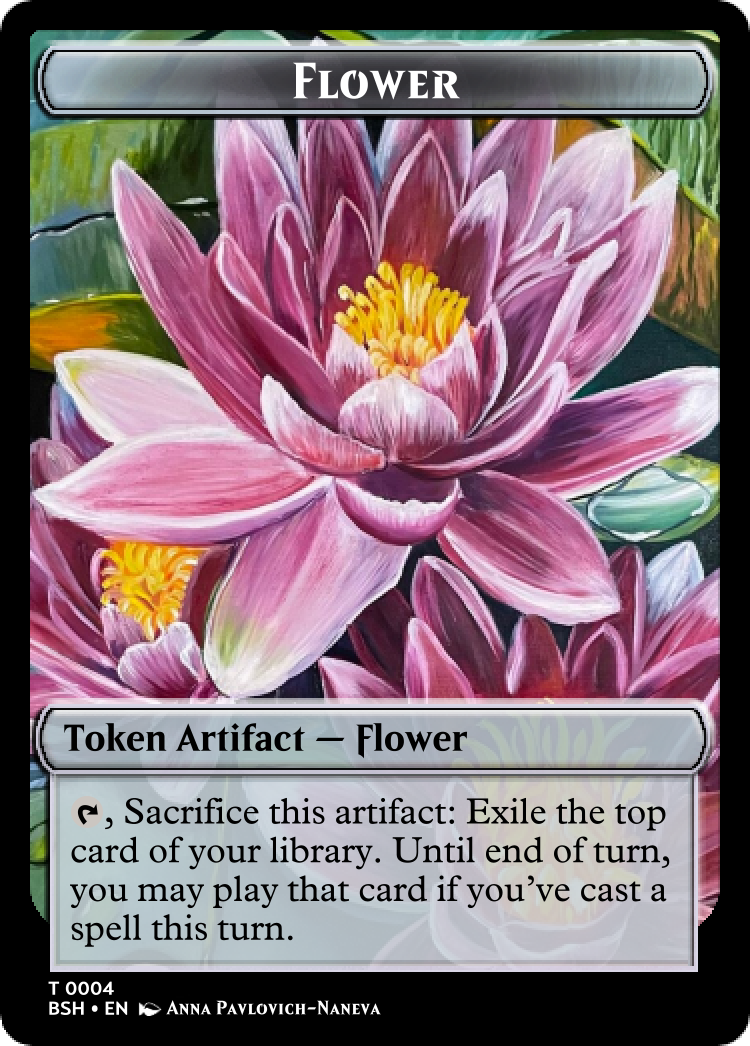
flower artifact token
Wake up and smell 'em. Card: Flower Token, Art by Anna Pavlovich-Naneva.

Bloom is an ability word with the general template "if you've cast another spell or sacrificed a Flower this turn, {benefit}" if it's associated with a spell. This changes slightly to "if you've cast two or more spells or sacrificed a Flower this turn, {benefit}" if it's associated with a triggered ability on a permanent. So there are two parts to Bloom, the first is that it's part of the "double-spelling matters" space, which is very common and well-established at this point. The other part cares about Flower tokens which are a new artifact token introduced in this set. They read: "{T}, Sacrifice this artifact: Exile the top card of your library. You may play that card this turn if you've cast a spell." So this is also clearly playing in the "double-spelling matters" space as well, but in a way that helps keep your train going, which can be a big struggle in limited for archetypes that care about playing cheap stuff.

For some background, my first experience with Magic was playing the Dogmeat precon, which included Junk tokens. I think Junk tokens are very fun, but it has been stated that they are unlikely to appear in a format like Standard, I would guess because they are too strong. So I took the idea of an impulse draw token and made it more conditional. I still kept it as no mana cost because I like the feel of it, and the double spell requirement still provides some nice guardrails. It's worth noting, these are the "bad" impulse draw, just like Junk, which makes the instant speed activation a bit harder to access. Here are some simple Bloom cards:

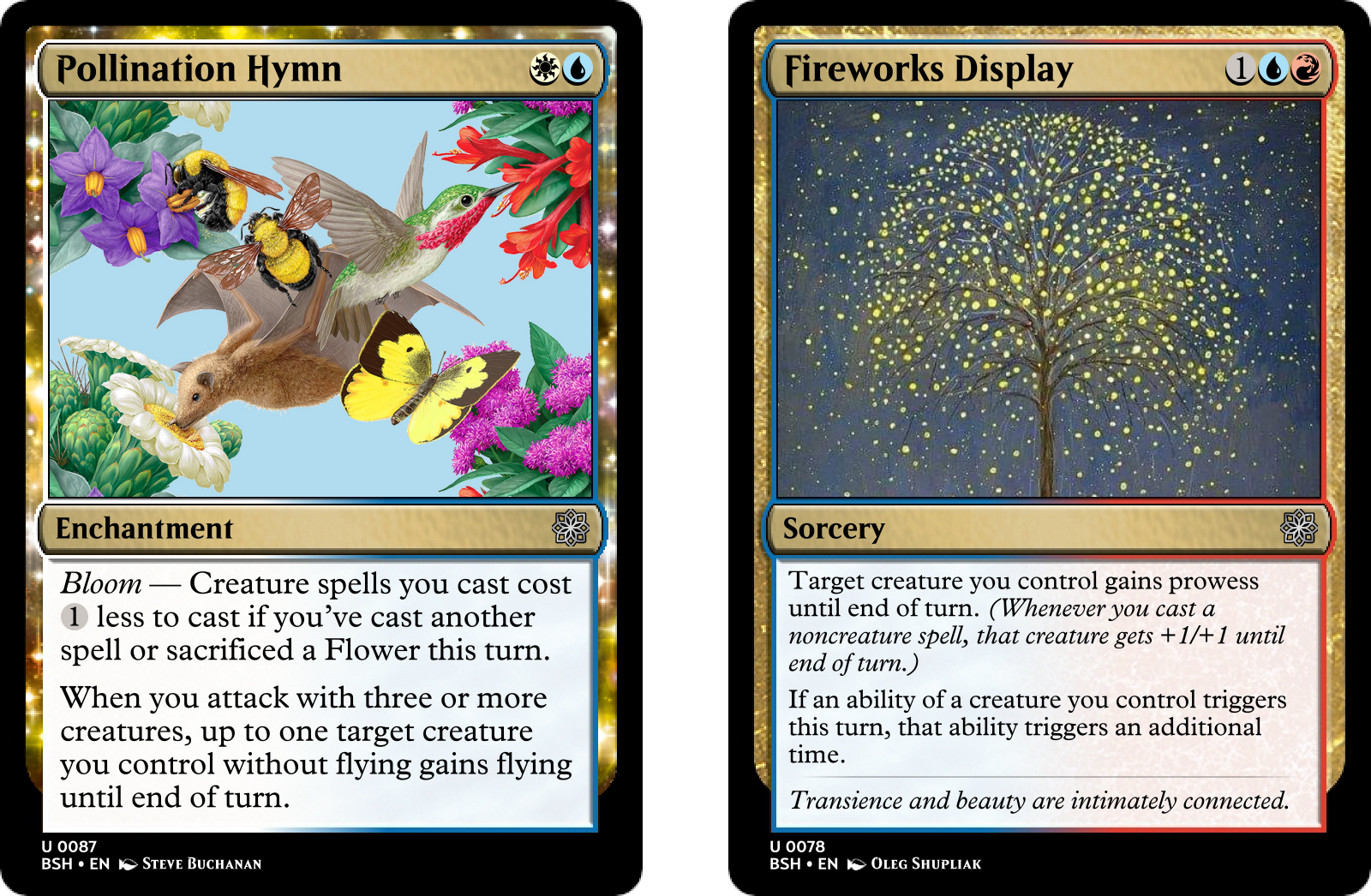
Bloom Commons
Bloom commons. From left to right: Smell the Roses, Art by Sparkles and Splatters. Sudden Sting, Art by Friedrich Brentel. Assemble the Buzz Brigade, Art by Hannah Willow.

While these aren't groundbreaking designs by any means, I believe they illustrate the intention pretty well. I think the flavor came together really well for these also; they all bring to mind springtime and have a distinctly Bloomburrow quality to them. Based on our established design goals, that's all you can really hope for, right? Design-wise, Smell the Roses is a Preordain that requires some additional setup. Sudden Sting becomes a more flexible Shock for creatures that has some unique synergies (like with Crimes for instance). And Assemble the Buzz Brigade gives you some fliers at a really efficient rate. Side note: the spring and flowers theming gives us a flavorful reason to include mono-white insect tokens as Bees! We won bee bros! Obviously, all of these are very efficient for commons if you meet the Bloom requirement, but I think the downside of when you don't balances that out overall.

Just as a general note on that topic going forward: balance is a really, really hard thing to get exactly right, even for the pros, and I clearly don't have the benefit of a playtest team to help me hone stuff in. I'm more concerned with inherently unworkable designs, i.e. cards that lack the proper knobs to balance altogether. Overall, I'm aiming for designs that are a.) compelling, b.) in line with the color pie, and c.) tunable to reach the right power level. As I've stated, this project is closer to a very fleshed out proof-of-concept rather than a professional product. That said, I'll certainly try my best to get the designs I show off roughly in-line with contemporary standards. And if you think I've really missed in one direction or another on any design, please provide that feedback!

garden tender
He's such a cutie. Card: Garden Tender, Art by GOTTE.

As bonus, here's what that templating looks like on a permanent. It's a bit awkward that it's a slightly dissimilar template to the spells, but I don't think it's disastrously unintuitive. Essentially, Bloom triggers become active as you cast your second spell or control a Flower. I think that would come through fairly well in actual play.

The draft archetypes for spring are Bloom Tempo and Flower Spellslinger. Essentially, tries to keep a steady onslaught of low-to-the-ground threats going via Bloom and cracking Flowers to maintain card advantage, whereas tries to build up resources and then use Flowers to fuel a big popoff turn with tons of spells and triggers. Pretty well-trodden territory with a lot of similarity to the archetypes from original Bloomburrow, which is somewhat intentional. As I've said, I'm trying to pay homage to what people loved in the original while providing a meaningfully different play experience (yes, of course we're still going to have cute otters slinging spells). We'll go into more detail on the specifics of these (and all other) archetypes' implementation in future posts.

Summer Mechanic: Sunbathe

Sunbathe is a keyword action which reads "tap target untapped creature you control and put a +1/+1 counter on it. Then add if that creature's power or toughness is 4 or greater." This concept mostly came about through flavor, your creatures take a break and come back refreshed and stronger. I also liked the idea of incentivizing you in some way to tap down your larger creatures this way as it creates some nice push-pull to the incentives and plays in the same space of other "power 4 or greater" matters archetypes. I also like the modality that adding mana gives to some of these spells. Often it is analogous to just a simple cost reduction if you sunbathe as part of a spell's resolution, but it can be ramp if it's strapped to a trigger or ability of a permanent. I like that it can be used that way, feels right for a green set mechanic. The fact that it gives specifically also makes it a bit less splashable while still giving it some utility in paying for neutral mana in non-green decks. I think there are also some issues with this mechanic which I'll get into later. For now, here are some Sunbathe commons:

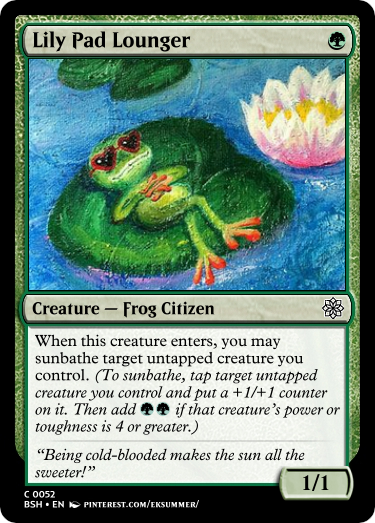
Sunbathe Commons
Sunbathe Commons. From left to right: Lily Pad Lounger, Art by pinterest.com/eksummer/. Refreshing Quaff, Art by Christina French. Belly Flop, Art by Jessie Robertson.

Lily Pad Lounger is a flexible one-drop that can enter as a tapped 2/2 off its own trigger, if you want. I like it, reminds me of Sunshower Druid from original Bloomburrow. Refreshing Quaff is a nice example of that potential off-color modality I mentioned. Four mana to get a counter, tap down your own guy, and draw two compares pretty unfavorably to other commons like Combat Tutorial, but the rate starts getting pretty exciting if you use that from targeting a big guy to pay for the draw. I will say, I think this one pushes mono-blue's color identity with the P/T matters and adding , but I figured I'd try it. And of course, Belly Flop is the humble bite spell. The rate is pretty poor at a baseline, but of course we have to work around that it's functionally one mana if it targets a big guy. Overall I think it's a fair rate at common. Love how the flavor on this one turned out too, a bigger guy is gonna make a bigger splash which is perfect for a bite effect.

The draft archetypes for summer are 4-Power fellas and Untap + Value. Once again, I'm not trying to reinvent the wheel here. Both archetypes here are intended as fairly mid-rangey. 4+ power matters is very common territory for , but I've tried to innovate a bit here by caring specifically on having as many creatures get up to that power as possible. That makes it distinct from Ferocious as it's not a pure threshold. This plays well with sunbathe as the creatures you've already gotten 4+ power with can hang back as blockers as you tap your smaller guys to build the army. The archetype tries to incentivize you more to build up one larger threat for repeated ramp effects while keep your smaller guys back. This is where the majority of the untap effects meant to mitigate Sunbathe's downside are concentrated since that is nice piece of mechanical overlap for not present in .

Overall, while there are aspects of Sunbathe that I like, it's the mechanic I'm least sold on of the ones I've developed for this set. It's a bit wordy (almost gives Explore vibes, which I'm not a huge fan of) and tricky to balance. Naturally, incentivizing you to tap down your own guys (especially your best ones) means you can't attack or block with them which can slow down the game and might feel unnatural/unfun to newer players. I also find that I'm putting untap effects on a lot of other cards to soften the blow, which is fine, but that's obviously something you want to be careful with. We also don't want to shave the edges so much that we eliminate the trade-off baked into the mechanic. It's not unworkable, but it is tricky.

And as I mentioned above, there are some aesthetic color pie difficulties with the "Add " aspect of the mechanic. Sunbathe is a very green mechanic, but the main payoff being temporary mana is a bit strange. Green is technically allowed to produce temporary mana, but it's not typical. I rationalize it as your big guys sort of becoming mana dorks, but it's debatable for sure. Red is primary in rituals so I think it's fair game there, but it is (at minimum) a pretty significant bend in blue. It's also a bit weird for off-color cards to make specifically, but I don't think that particular aspect is a big deal (see Firebending from TLA). I'd be very curious to hear feedback on this mechanic. Do you like it conceptually? Should it be reworked or maybe even scrapped? Any ideas for other mechanics which can evoke that "summer feeling?" I'd love to hear others' thoughts.

Wrap-up

While we still have three more mechanics to go over, this post is already getting pretty long. I just love talking about the nitty-gritty design details and turns out there's a lot to say! Here's an artistically unassailable graphic (coincidentally by me) that summarizes what we've covered so far:

Limited Archetypes (so far)
Limited Archetypes Revealed so far (with some hints)

Next time we'll do the remaining new set mechanics not covered here. Eagle-eyed readers may even notice some foreshadowing in the graphic of what's to come next time 😉. I hope you've enjoyed reading, and thank you for your time. And of course if you have any feedback or thoughts on anything discussed so far, I'd love to hear it. See you soon!