Bloomburrow: Seasons' Heralds - Core Mechanics and Structure, Part 2
Today, we'll be covering the remainder of the season-themed mechanics which we didn't get around to last time. To recap, the spring mechanic is Bloom, which rewards you for double-spelling and/or sacrificing Flower tokens and the summer mechanic is Sunbathe, which allows you to tap down your creatures to buff them with incentives for tapping larger creatures. Now let's get into the rest of the seasons!
Autumn Mechanic: Harvest
Harvest is a fairly straightforward keyword action with the reminder text: "To harvest, sacrifice a noncreature permanent." So you harvest, typically in response to a triggered ability or as an additional cost, and as a result you get some benefit. This is very comparable to Bargain from Wilds of Eldraine except it is not only tacked on as an additional casting cost, and the valid types to sacrifice are different. Clearly, harvest is meant to evoke pastoral traditions associated with the fall season (it is in when the harvest comes in after all). The noncreature clause is actually a design constraint from original Bloomburrow that I think makes a lot of sense to carry over here (no one should be sacrificing their offspring in Limited!). And obviously the denizens of Bloomburrow aren't cannibals, so harvesting your fellow squirrels and bunnies is just dissonant regardless. Here are some building-block Harvest designs:
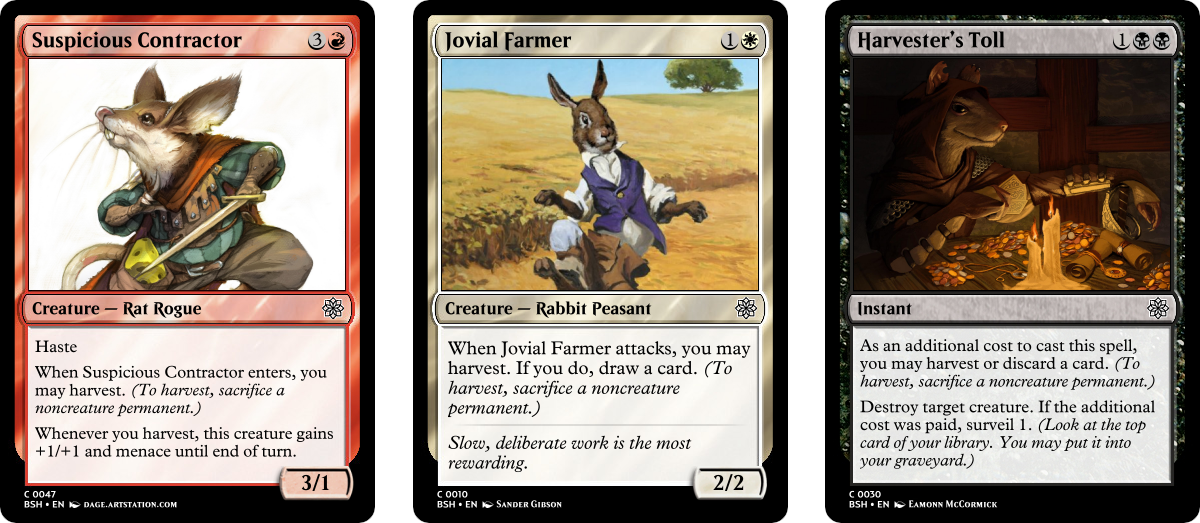
As I mentioned, the mechanic is simple, but you can see that allows for an extremely wide design space, which is both good and bad. Starting with what I like, the flavor on the keyword is fitting and versatile. In BSH, Harvest mostly meant to evoke the agricultural meaning, but the word harvest has some sinister connotations as well. You can see that here in the contrast of Jovial Farmer vs. Harvester's Toll. One evokes the joy of the harvest season while the other plays into the idea of a con man "harvesting" peoples' money. I also like that Harvest can be used in a lot of different permutations, mechanically. Just in these three cards, you have an aggressive 4 drop with a self-enabling harvest ETB that scales nicely in a dedicated build, a 2-drop which can potentially yield some value if you find the space to swing with it in the mid to late game, and a removal spell which harvests as an additional cost. This is also nice when designing the autumn "wedge" as it is broad enough for designs that fit nicely in , , or .
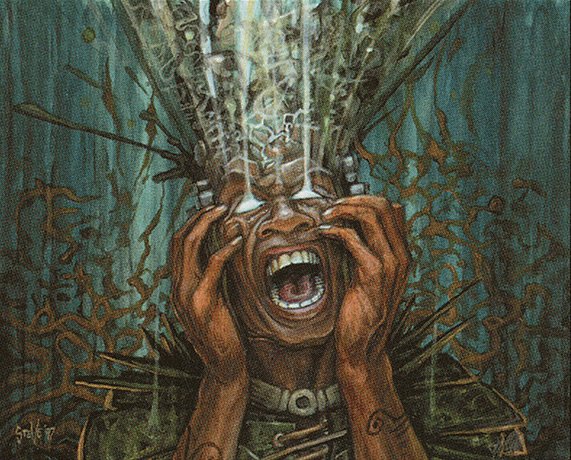
However, this breadth has some challenges as well. As you may have noticed, I kept the wording on Harvest open to sacrificing lands. This is controversial design space, particularly for casual Limited play, as it can lead to new players shooting themselves in the foot, suffering under decision paralysis, or feeling forced into "feels bad" plays. This is totally fair criticism, but I think there are some great counterarguments to this which ultimately led me to keeping it this way. The strongest argument in my opinion is Harvest allows for what Mark Rosewater calls lenticular design, which essentially means it affords players of a high skill level access to depth within the mechanic which might be invisible to newer players. I think this is really valuable for a mechanic to provide. Harvest is particularly useful for aggressive archetypes as the land sacrifice gives them some additional reach in games where they flood out. It's not too dissimilar to Landfall in that way, except it introduces actual, meaningful trade-offs and thus introduces more critical decision-points (I'm kind of sour on landfall as a mechanic right now, can you tell?).
"But how does this address the 'feels bad' problem for the non-spikes?" you say. Well, it doesn't, but my perspective is that your average casual pre-release player won't even make the connection that it's allowed and will just stick to safely sacrificing their Foods and Flower tokens, which is the main intended use case for the mechanic anyway. There's more I could say about this, but I think that's more than enough for now (isn't it beautiful how much you can yap about even the simplest mechanics in a game like Magic?).
The draft archetypes for autumn skew more on the fast side with being your traditional aggro strategy. Harvest often and early to build an overwhelming advantage before you run out of steam. By contrast, is a bit slower while still being very tempo forward, with a bigger focus on sacrifice synergy and recurring some of the cheap material you've sacrificed to lean slightly more into the long game. Overall, I think both of these playstyles are positioned to be well-served by Harvest.
Winter Mechanic: Hibernate
Hibernate is a keyword ability with the template "Hibernate {cost}" and the reminder text "You may cast this card from your graveyard by paying its hibernate cost and sacrificing a noncreature token. If it's an instant or sorcery, exile it." So it's essentially a flashback variant with two unique aspects to it, 1.) hibernate has you sacrifice a noncreature token in addition to paying the cost and 2.) it is functional on any spell type. Originally, it only cared about sacrificing Food (clearly inspired by Forage), but eventually I decided to expand it out a bit. This was to prevent it from being too narrow/parasitic and because there are a lot of different tokens flying around in this set. Having another set mechanic (in addition to Harvest) helps ensure there's proper "token churn" and prevents board clutter in Limited. Here are some basic Hibernate designs:
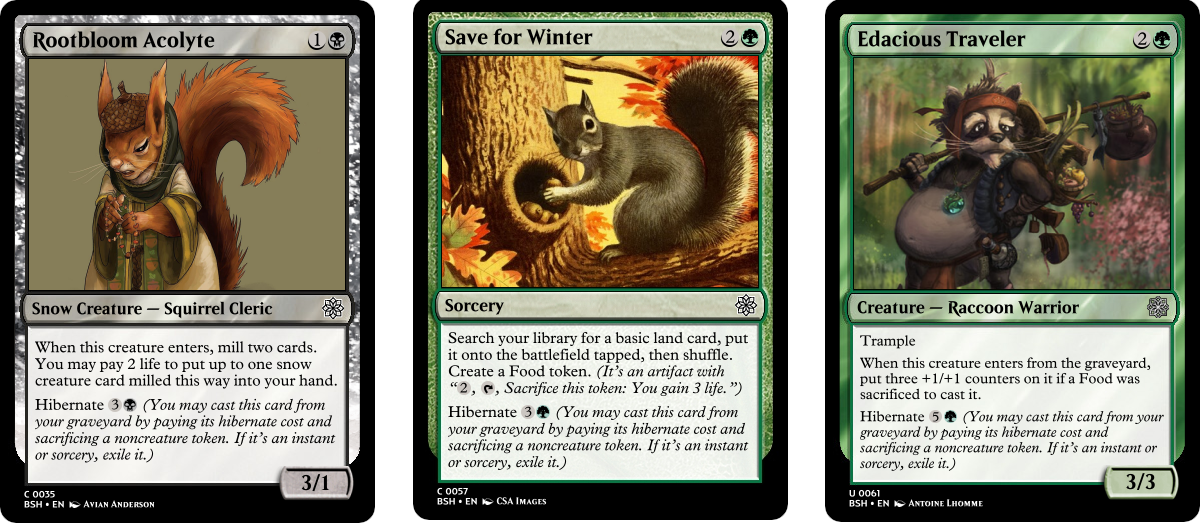
So yeah it's certainly a graveyard mechanic. Having some archetypes focus on the graveyard is another design trick that just seems to make Limited environments work better, so it makes sense to include here. It's mainly used to recur creatures, but you can see how it can fit really well mechanically and thematically on a card like Save for Winter. The requirement to sacrifice a noncreature token to revive creatures also (hopefully) prevents repetitive play patterns of constantly recurring the same threat in grindy games without relying on something like Finality counters. I also really like how the flexibility in the token sacrifice aspect can let us lean into some nice flavor, like what we see with Edacious Traveler. After a nap and a nice meal, he comes back as a real house! We can still get the flavor of eating food for hibernation when it makes sense without having to commit so hard on that gameplay-wise. However, you might notice a pretty auspicious inclusion I snuck in there with those other cards. Rootbloom Acolyte is a snow card! I mean come on, you simply can't do a winter theme without incorporating a snow subtheme, it would just be wrong.
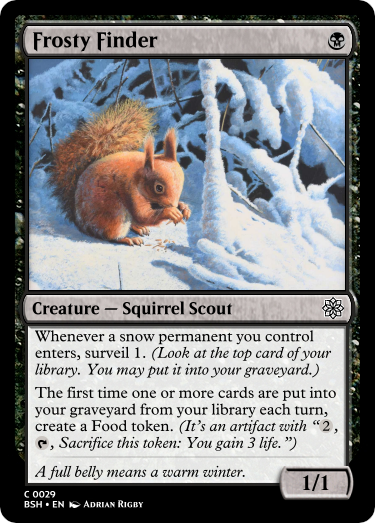
Fun fact: the snow synergy was the original idea that inspired this entire set. I saw a squirrel rooting around for food in the snow last winter and when he pulled his head out from the layer of frost he'd buried himself in, there was a little pile of snow on his head for just a split second! I just thought it was so cute and quaint that it immediately reminded me of Bloomburrow. I had the idea for Frosty Finder as I continued my walk, and now here we are. So, yeah, the winter theme is a bit different than the other seasons where it is actually split among two themes. The archetype is a grindy Hibernate theme and the archetype is Snow control. However, as you can see from Rootbloom Acolyte, there is clearly some crossover between the two. The archetype still has a lot of focus on graveyard shenanigans, so it still plays well with Hibernate as a mechanic. And just to give you an idea, here's some snow cards:
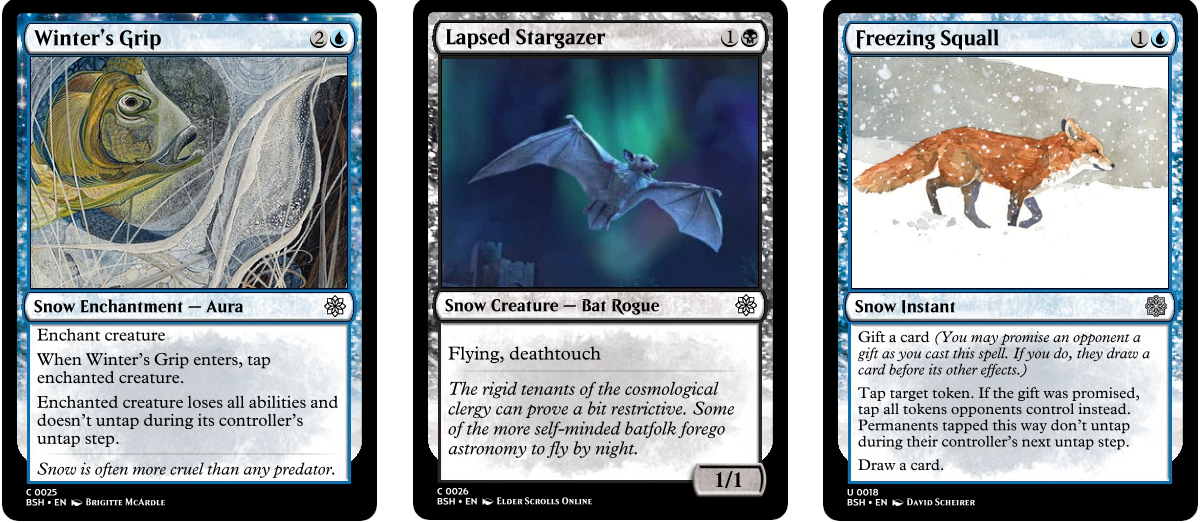
One thing that's nice about "splashing" snow in a set is you can (at the risk of sounding careless) just slap snow on otherwise totally functional, work-horse limited designs and boom you've got an extra dimension to certain cards for people to fight over. If you're a midrange deck, you'll certainly take Winter's Grip if you're low on removal, but if you're building a snow deck, you might take it a little more highly since you really need a critical mass of snow for the synergy to pay off.
Balance Mechanic: Equinox
And that brings us to our final set mechanic, Equinox. Equinox is an ability word that doesn't have a strict, consistent template, but generally indicates cards that care about you and an opponent having the same amount of some resource, or otherwise giving your opponent a bonus so you can get an additional one. So you can think of it as analogous to a group hug mechanic, but designed to work in a 1v1 environment. I would wager this is the wonkiest mechanic I'm playing around with here by a fair margin. It's never really been done in significant numbers in Magic before, and certainly not as the backbone of a dedicated limited archetype. While there's likely a very good reason for that, I figured I'd try it out just to see how it feels. Clearly, a mechanic this unorthodox requires a bit more justification/explanation, but before we get into that, here are some cards:
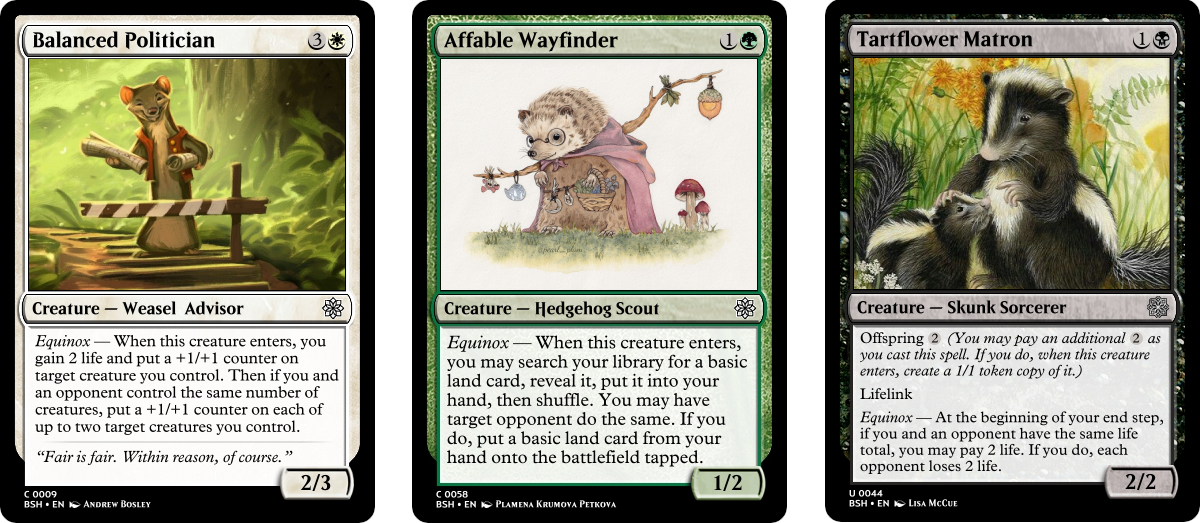
Even in the preliminary design process, I've already pushed up against some limitations and challenges that I think are inherent to this design space. For one, it's just pretty hard to design commons for an archetype like this. It's a wordier mechanic that just kind of wants to be on higher rarity stuff. It also really pushes you into pretty strict floor-ceiling designs, i.e. if you don't meet the criteria, do a thing and if you do meet it, do a stronger thing. That's fine, but unlike Bloom, it's difficult to evaluate the difficulty and consistency of hitting that ceiling since the criteria is often more dynamic and contextual. Having Equinox as a fairly loud theme also naturally drives you towards cards which feature catch-up style mechanics, which is another tricky aspect to find the proper dosage of.
The designs above do an okay job by being serviceable at a baseline with some interesting dimensionality if played into. Balanced Politician is a slightly flexible 3/4 in total stats with a lifegain trigger, and it can become a juiced version of Felidar Savior when you trigger Equinox. Affable Wayfinder is a bog standard color fixing design with the ability to be ramp if you help out your opponent a bit. I really like this as the ability is typically not worth it in the early game, but it can be a nice way to enable Equinox effects that care about equal hand size later in the game as you're essentially populating your opponent's hand with the lowest value draw they can get (this is also lenticular in a way I really like). And then Tartflower Matron is a playable but unexciting french vanilla creature with the ability to really accelerate the game if you manage life totals carefully. This is a pretty interesting payoff in a life gain deck as you can really make this lopsided after getting low by finally ripping the life gain effects you've been holding up to keep Equinox on-line.
As far as Limited archetypes go, is more of a Gift Tempo deck. It looks to establish a solid board presence with gifts and then break symmetry with Equinox cards that benefit you and your opponent controlling the same amount of on-board resources. Then is a slower strategy, between midrange and control, with more of a focus on manipulating life totals by using a combination of life gain and pay life effects.
Even though there are challenges to Equinox, there are some pretty good arguments for it as well, especially in this context. For one, Gifting is an exceptionally good synergy for Equinox as it really gives you some play in manipulating your opponents' resources. In some ways, Equinox is just continuing the exploration of the design space already scoped out by Gift. Also, these designs really play well in a Commander-centric world. EDH-heads love their political plays and their secretly evil group hug decks (which original BLB had the poster-child of in Ms. Bumbleflower ), and Equinox is a natural fit for that.
Wrap-up
That introduces all the major mechanics in Bloomburrow: Seasons' Heralds! Here's a summary graphic I put together for the mechanics and Limited archetypes:
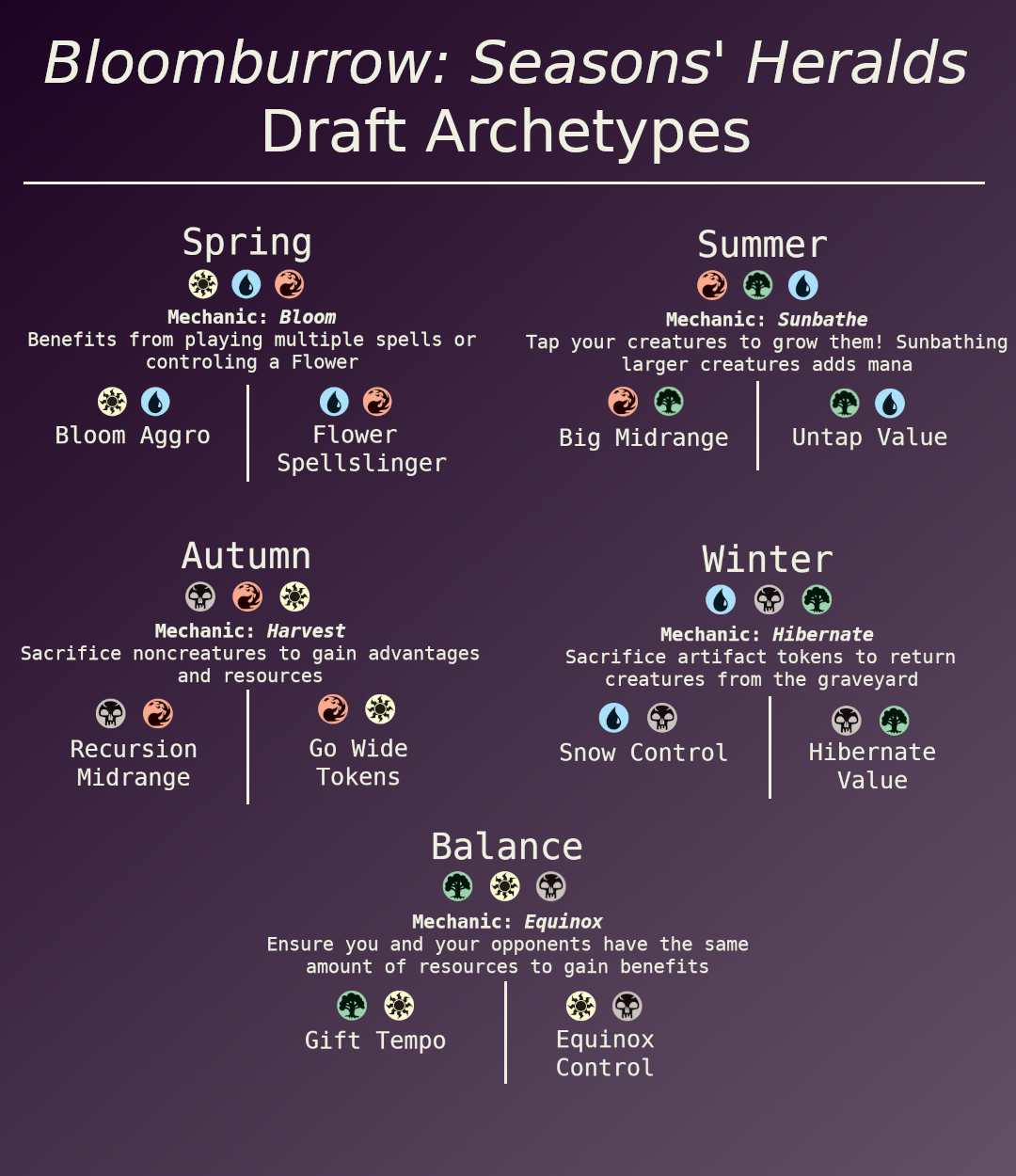
It was really a blast to put this together. Thinking through everything while writing also helped me crystallize and refine a lot of my thoughts on the design process, which was another goal in me doing these blogs in the first place. While I would love for lots of people to read this and give me feedback, I recognize the audience for something like this is inherently a bit limited by virtue of it being a niche topic within an already niche topic. So it's really helpful as a "design journal" for me to explore the subject through a different lens. To me, that makes this worthwhile and fulfilling regardless.
In the next post, I'm going to discuss the signpost uncommons for the Limited archetypes, as well as some other cycles which I think will be important as "glue" in the context of draft, and others that I just think are neat. I hope you'll join me for that and until then, I look forward to any and all feedback from anyone that read this, skimmed this, or just looked at the cards! Thanks for your time, as always.